Water for life
Waterwell project update
The photos were included on 30 May 2005
Roger Wearn
Practical note
It only needs 50 people to donate the equivalent of one year's water bills to provide water for 1,250 Zambians for years to come! Once the startup costs are covered it only takes a further 15 donations for the next 1,250 recipients ...
Once the drilling is under way the plan is that it can become self-financing by providing a drilling service for other NGOs.
Pledges can be made to water@rogertech.co.uk
Chifubu compound, in north-east Ndola, is home to 60,000 people, many of the poorest don't have access to clean water - what use is one pump, or ten pumps, or ... ? Take a look at 'The daffodil principle' for an answer.
Semantic comment: the word 'compound' is used to describe the Zambian equivalent of a UK housing estate or housing area. But these compounds are typically for the poorer residents with very basic homes on a small plot, some of the better ones having electricity, rarely having a tap or toilet indoors. The poorest are built of mud bricks (that get eroded by the rains) and instead of corrugated iron roofs have grass roofs. These compounds are quite distinct from a rural village setting which has a well defined centre without precisely defined dwelling plots.
Thu 28 April 2005 - Received an email from Andy that describes a new design of hand pump:
"We have an opportunity to introduce a new design water pump into the villages- one that uses a revolutionary new design that could be manufactured in-country and installed in existing or new wells. The design is very light weight and can be easily maintained by the women of the community. The attached .pdf file has a description of the pump.
The pump works by hydraulic action. When the pump handle is pushed down, water is forced down the pipe compressing the pump spring. When the handle in raised, the spring forces water up the flexible riser and out the spout. The thing that makes it different from regular pumps is that the well head can be at a distance from the pump, and that simple wrenches are the only tools.
Richard Cave (paper's author) is keen to have this pump introduced into third world countries where there is a desperate need for clean uncontaminated water. Zambia could be one of the target areas and it could be manufactured and installed by local people. The simple rugged lightweight design and ease of maintenance makes it an ideal water pumping system. It can be maintained using a few simple hand tools and locally available parts. Using a single flexible line from the downhole pump to the remote drive unit/outlet remote from the well bore contamination of the well from users can be minimized. This pump has been tested locally for over 1400 hours without problems and works to depths of over 100 feet."
See also members.shaw.ca/lsdillon/
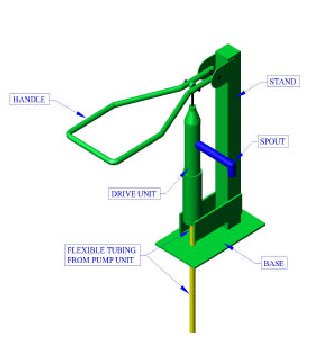
The Awassa pump
Sun 1 May 2005 - Had a great conversation with Richard Cave in Canada about the Awassa hand pump and the possibilities of its deployment in Zambia. He is very keen to see it exploited in places of greatest need.
Mon 2 May 2005 - I received this amazing email from an associate pastor of Santa Maria Vineyard, California:
Roger,
I was just in Zambia 3 weeks ago at that time we took possesion of a trailer mounted drill rig that is a little bigger than the one that you have pictured in your web page. We are very excited about it and are going to start drilling with this rig in July. I am the founder of Seeds of Hope International Partnerships and also working part time with Lifewater International. I have some webpages that you could look at for some more information about us and our heart in Zambia (although a little out of date - www.vineyardsmv.com/zambia). We are helping to equip the local church in some tangible ways to reach out into their communities. A lot of what you mention on the web we or our partners are doing there as well. I am overseeing a large project in Zambia based in Ndola and I would love to talk to you regarding any of your questions. We have overseen the drilling of 29 boreholes last year, repaired 61 broken handpumps, trained 112 pump caretakers and taught classes in Hygiene and Sanitation to 860 people in northern Zambia. Most of the wells that we oversaw last year were drilled in Kasempa region. Although we would have some information that we have gathered in Ndola and Ndola rural areas. We are overseeing the drilling of 13 wells in Ndola this year, God has opened up some incredible doors for us and we feel that we have some real opportunities to spread His kingdom through this region. If you have specific questions on the geology I could answer them easier or send them on to one of our team members who is a geologist. Let's dialogue some more,
God bless you,
Kirk Schauer
kirk@vineyardsmv.com
www.vineyardsmv.com
Tue 3 May 2005 - Had another great conversation, this time with Kirk, from the Santa Maria Vineyard in California.
Managed to get through to Francis Faruka, the new Ndola Vineyard pastor overseeing the water projects referred to by Kirk (above), and agreed to talk some more on my arrival.
Check out the link above and Seeds of Hope.
Wed 4 May 2005 - The trip to visit Isubilo, Ndola, for 3 weeks. To prepare the way for well installations. Key aims:
- To negotiate proposed sites
- To explore ownership of potential wells
- To begin the process of establishing well management and pump maintenance
- To seek out co-operation with the Seeds of Hope initiatives already underway in Ndola and northern Zambia.
Thu 5 May 2005 - Touched down in Lusaka at 06:15 expecting to take a taxi into the city and then a 4 hour coach trip to Ndola. Not this time. We touched down in Ndola, via a new connecting flight, at 08:15!
Met up with old friends at the Isubilo centre mid-morning.
Lunch with Andy & Eira and discussed the latest well project developments.
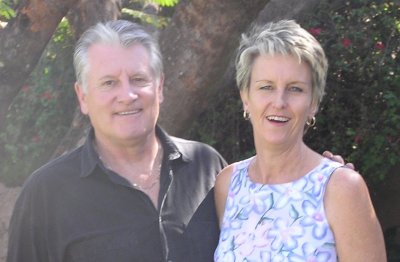
Andy & Eira Patching
Setting up a meeting with Francis Feruka, the Vineyard pastor, seemed to be the next thing to do.
I phoned Francis, and he suggested a meeting for the next day at 10:00!
Fri 6 May 2005 - Isubilo management meeting - at the end of which Andy outlined the reason for my return and the goals of the water project.
10:00 and the meeting at Francis' house along with Obby Kafunda, the administrator, and Joseph who has been responsible for the pump repair training teams.
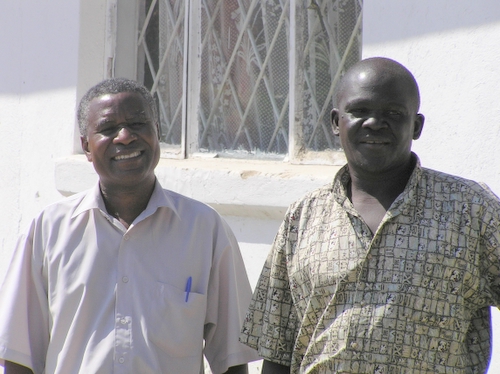
Francis and Joseph
We shared our goals and visions and developments to date. With Seeds of Hope and Lifewater, they have:
- bored 26 wells and installed hand pumps (India Mk II) in 26 schools in the Kasempa region as part of a UNICEF project
- bored 3 wells and installed pumps in three churches
- trained 30 volunteers in pump repair/maintenance and repaired 61 pumps
- held 28 hygeine and sanitation training sessions
- held 3 water quality monitoring training sessions
- held 1 HIV/AIDS and malaria prevention methods session
- held 2 agricultural methods (inc drip irrigation) sessions
- held 6 agricultural methods of different crops and irrigation methods uing the treadle pump sessions
- held 1 business management session
- held 1 children's ministry training session
- conducted outreach concerts in 2 locations
The Santa Maria Vineyard has purchased a plot of land for the new church plant of the Mapalo Vineyard, located in Chipulukusu, in the east of Ndola. The Chipulukusu compound is home to 40,000 of some of the poorest people in Ndola. Francis, an ex-chief accountant with a mining company, has been sent out from the main Ndola Vineyard as its pastor. (Chipulukuku is being renamed Mapalo.)
The current UNICEF project has brought 26 wells to the rural Kasempa region. The remaining 12 wells of the project are destined to be located in Ndola schools. Their location has yet to be decided.
I was given lunch at Francis' home and then walked to a nearby shipping container where a drilling rig is stored. This rig was shipped over by Kirk's organisation, 3 weeks ago, in anticipation of self-drilled wells. (The wells to date have been bored by a commercial company.) A team from Seeds of Hope/Lifewater will be coming over in July to start the training in the use of the rig. This rig is far larger than the Consallen Forager-55 rig initially proposed on the Water for Life project. There are advantages and disadvantages to both. Simply put: the larger - the quicker to drill, but has greater access, towing, training, staffing issues; the smaller - the slower to drill, but non of the above!
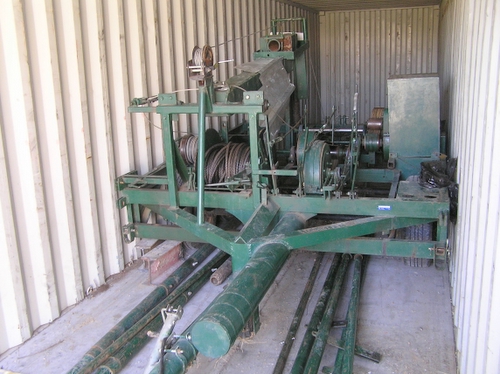
The new rig
They showed great interest in the Awassa hand pump, especially Joseph, because of the benefits in ease of pump maintenance and the potential of its local manufacture and therefore lower cost.
Francis outlined the greatest personnel needs for the project as the training of:
- welders
- electricians
- accountants
- well drillers
He showed me the plan of the new church plot - or more correctly - the Mapalo Community Resource Centre (Isubilo is also titled as a Community Resource Centre). It includes, in addition to the obvious meeting centre and associated rooms, welding and carpentry workshops along with agricultural training facilities.
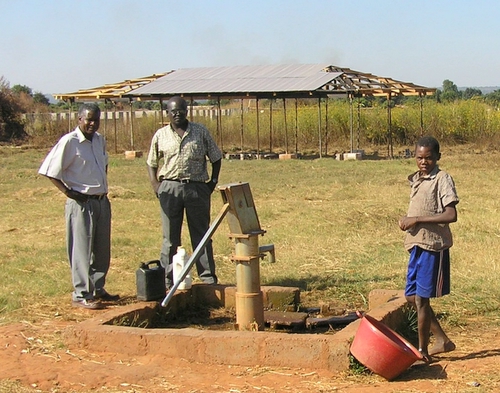
Later in the afternoon we went to the plot to see the newly-built caretaker homes, the temporay shelter for the Sunday childrens' meeting and the skeleton of the first meeting room complete with a quarter of its roof. Three months ago a South African Vineyard installed a well and hand pump on the site which is used by many from nearby homes.
The new church building in the background
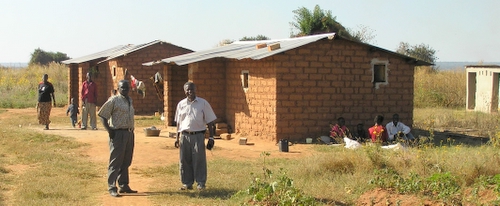
The caretakers' homes
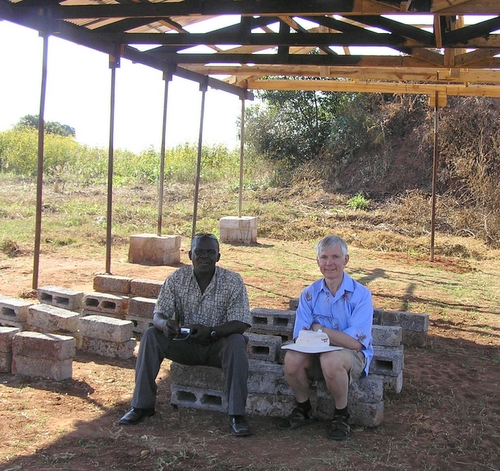
The pews were rather hard ...
Francis expressed a keen interest to be shown round Isubilo to see how they are meeting the challenges they find in the community.
We parted with an invitation for me to join Joseph and Obby in meetings with school heads and residents groups in the the nearby compounds to establish locations for future pumps.
Sat 7 May 2005 - My first day of relaxation! It really is beautiful out here.
I phoned Andy and shared the events of the previous day. He was keen for Francis to visit Isubilo and would contact him later in the week.
In a phone call to Francis (to discover when the pump location planning visits were going to take place) I heard his bad news. The battery of their truck had been stolen. This truck, provided by Santa Maria Vineyard, is Francis means of transport both for delivering materials to the church site and getting around. So the visits were on hold.
So, the question to myself was, "Should I borrow a vehicle to facilitate this?"
Sun 8 May 2005 - Lunch with the Patchings, and Andy is able to lend me a vehicle for next Wednesday to take Obby and Joseph on pump location visits.
"Your People" church in the afternoon - rather like Vineyard but less structured ...
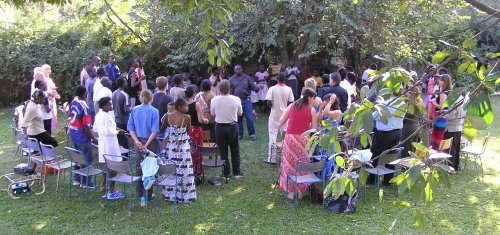
Mon 9 May 2005 - I accompanied Derry, Josie and Tony on one of their SOBIA outreach visits. They have been meeting with pastors in three local compounds for nearly two years. The goal is to achieve team-based community self-help sustainable projects. This is being achieved through a coming together of the churches in seeking solutions to the poverty in their communities. A measure of success is within sight. An example is the lady who was lent two doe and one buck rabbits. She now has over 30 and is able to sustain her family with this mini-enterprise. The most poor with the most orphans are the target group.
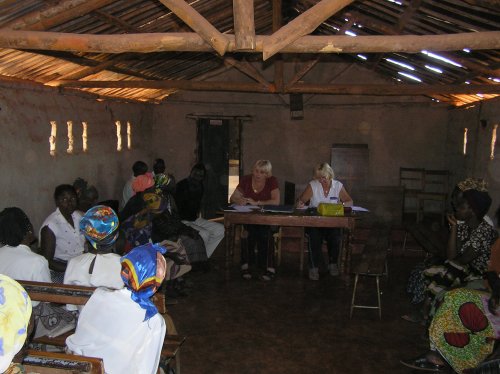
SOBIA outreach
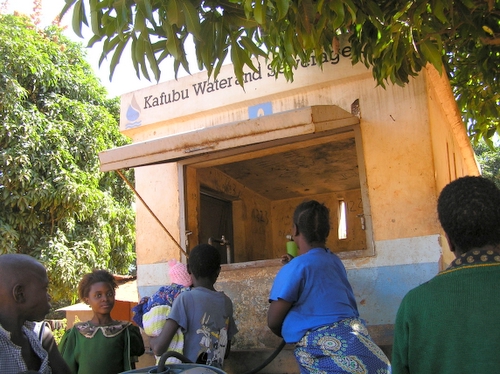
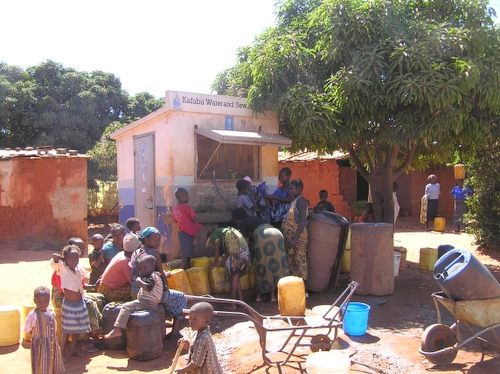
The Kaloko compound was created as an Ndolo overspill of the very poorest people. Their homes are made of mud bricks backed in the sun. The heavy rains erode their homes. To give an idea of size: it takes a quarter of an hour to cycle from one side to the other. This compound houses at least 13,000 people, their water is supplied from six 'kiosks' and three taps. These kiosks are provided by the local water company who charge 20 Kwacha (K20) per 20 litre container. K100 is just over 1p. But if you have no money ...
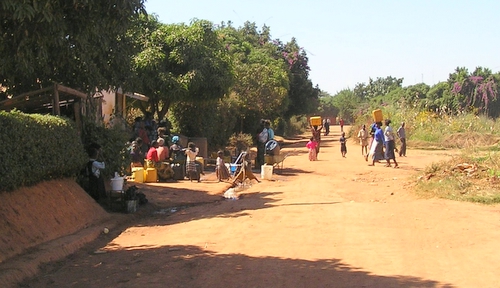
In speaking with the headteacher of the school, which has its water supplied from the water company too, he said that they had attempted to get an independent water supply via a bore hole. But the well drillers had no success in finding water at a considerable depth. The Catholic Church also has a bore hole but it is said to be dried up.
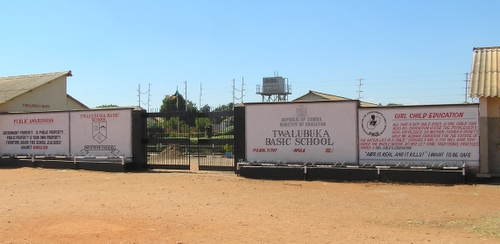
The school in Kaloko
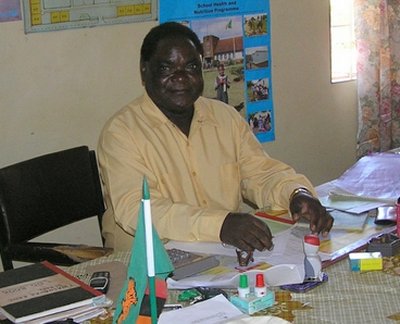
The headteacher
One of the pastors of the Baptist church, Alec, where the SOBIA outreach is based, was keen for me to speak with the RDC, the Residents Development Committee. He has been a member for three years, moved to live in the compound to pastor the church, and is most anxious to see the people helped. Water is so crucial to the well-being of the community. He informed me that the 'overseer' of their RDC, who also oversees several others, would be visiting the following week and asked if I would be able to speak to him.
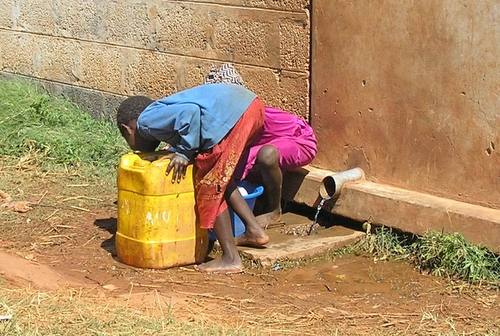
The children are very shy about having their photograph taken, these
two were collecting water from a drain
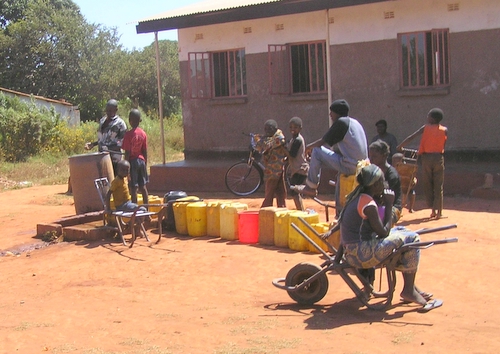
One of the three taps
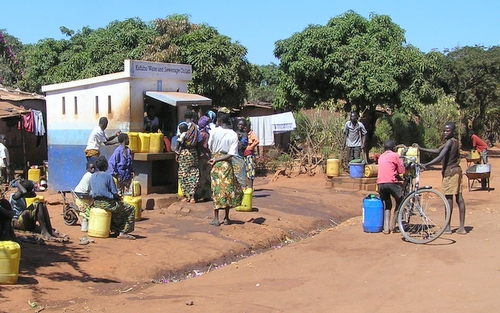
Another of the six kiosks

She wheels her wheelbarrow through ...
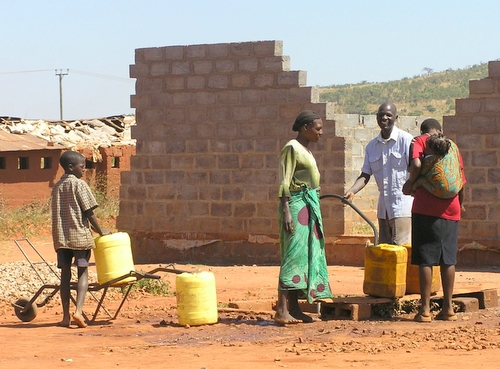
Another of the three taps at the Baptist Church ...
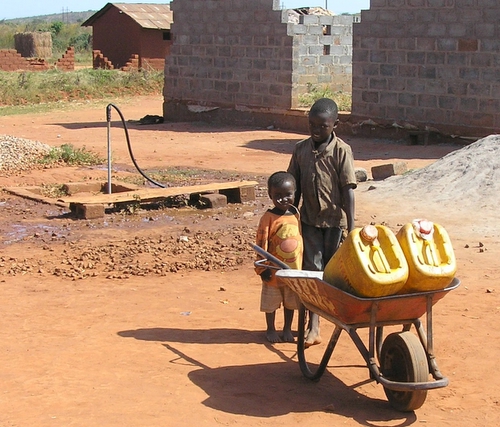
... another wheelbarrow
It would take up to 30 hand pumps to satisfy the basic water needs, not taking account of local agricultural irrigation needs. But is water available and at what depth?
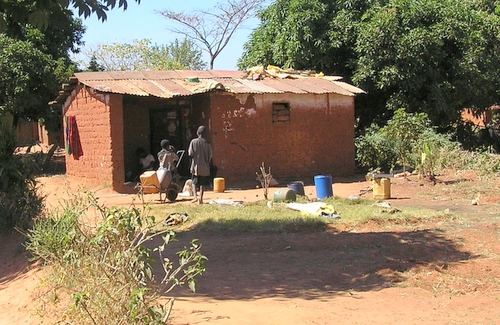
A typical home in Kaloko
The maize has suffered very badly this year as no rain came in a crucial part of its growing cycle. Early-planted maize is now being successfully harvested and being sold, but at fairly low prices - quite unaffected, at the moment, by the impending and considerable shortfall. A major shortage will occur with prices so high as to prevent the purchase by the poorest to eat, and for buying to sow for next season.
Wed 11 May 2005 - Visit to potential well sites for the UNICEF/Seeds of Hope project.
My daughter Karen and Francis' daughter Joy accompanied myself, Joseph and Obby on this trip. Andy had kindly lent us a vehicle and we went over 50Ks into the bush (not into local Ndola compounds as I had anticipated).
First stop was to Chondwe Prison, school and clinic. We were greeted by the headteacher who showed the extent of their water problem. There is a large pond about a mile from the school from which the water is drawn. The prison farm have a couple of large vegetable patches nearby. Water that is taken from the pond has to be treated with chlorine and/or boiled. The UNICEF project's involvement with the the school has already brought four deep pit latrines. Adjacent to the prison is a clinic. By the clinic is a newly-dug bore hole and a tower-mounted water tank - they have been their several years - but there wasn't enough money for a pump! A site was agreed for a new bore hole and pump to be installed near the school.
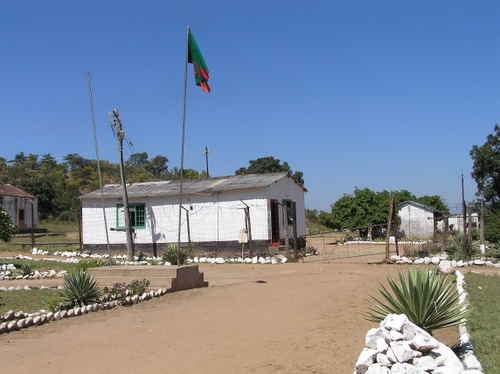
The prison ...
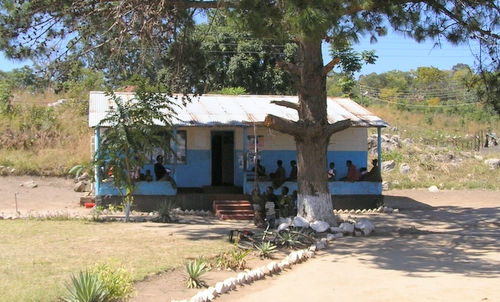
... and clinic
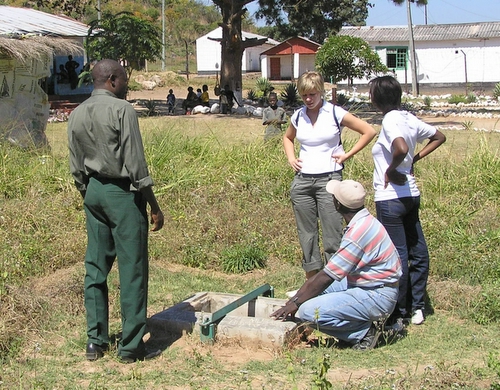
The bore hole - but the money ran out - without a pump
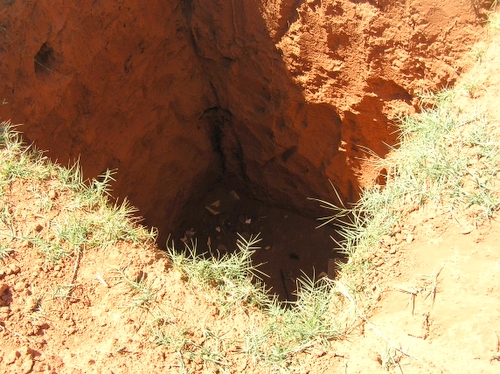
Newly dug pit latrine at the school ...
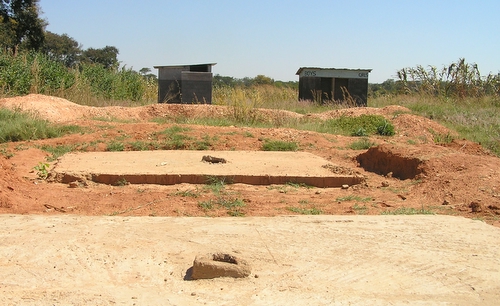
... these capped ready for brickwork
(but it takes a lot of water to make cement)

The derelict pump house
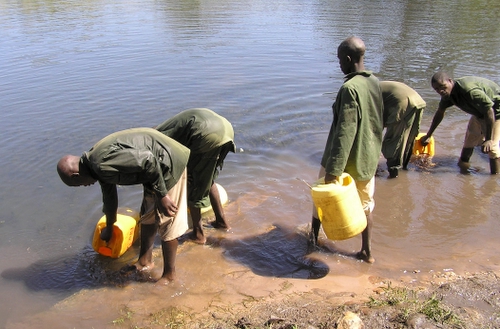
The prisoners draw water ...
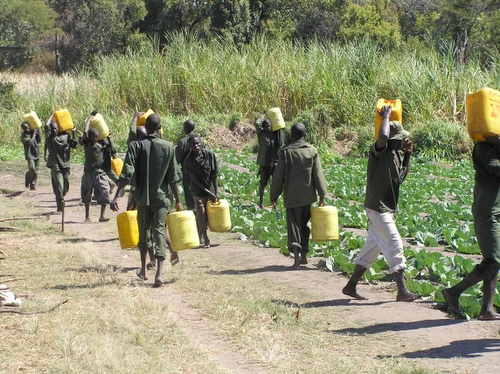 ... to irrigate their vegetables
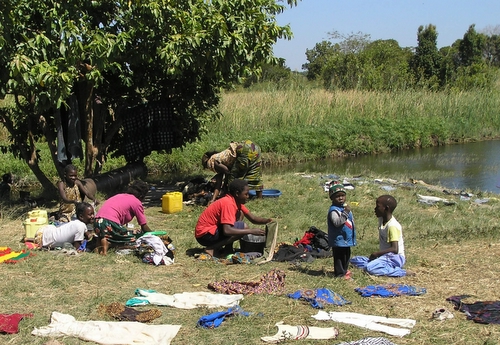
Washing clothes ...

... washing some lettuce
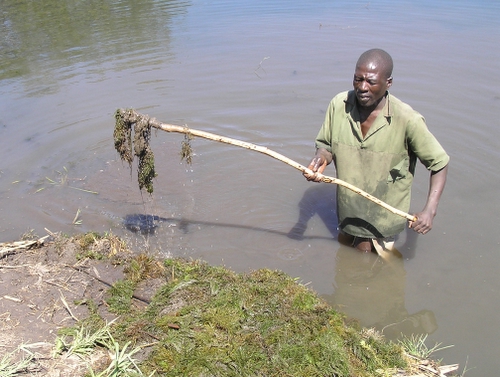
Removing the pond weed
Further into the bush we stopped at a school to look at a recently provided hand pump.
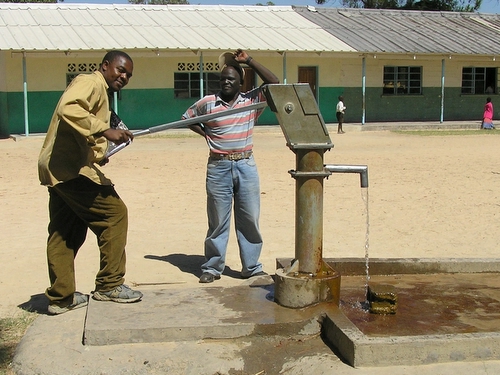
Obby and Joseph demonstrate the pump
Further on again to check out the work done so far, at a school at Mutaba, on the deep pit latrines - their pump had already been installed. Then it was lunchtime ... and a lovely picnic in the shade of big tree - the Zambian winter weather equates well to perfect hot summer days in the UK!
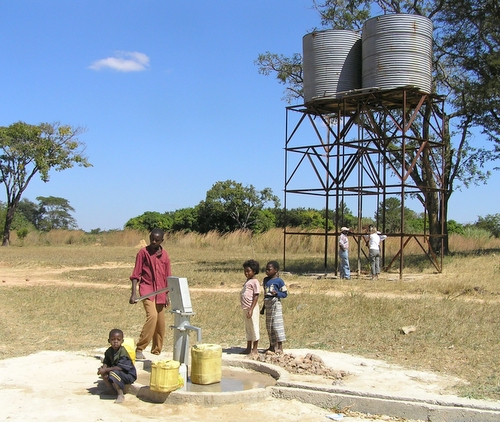
The tanks in the background - from a bygone era when electric pumps
were commonplace
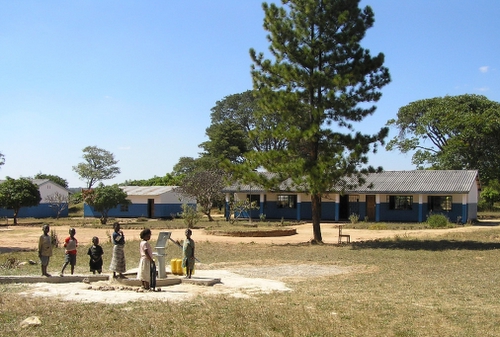
The school in the background
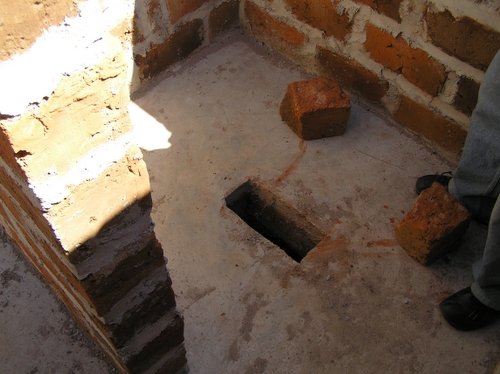
One of the new latrines
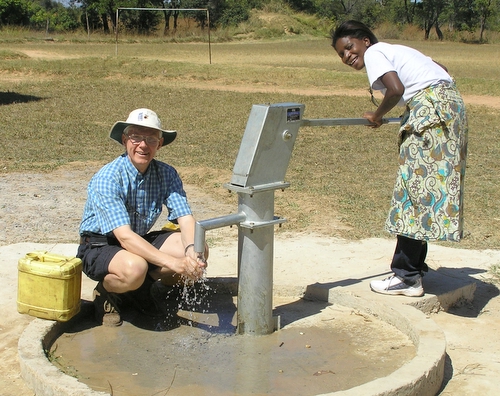
Hand wash before our picnic
The last visit was to another school, this one nearer Ndola, where the pits for the latrines the latrines were in progress and a bore hole, lined with a six inch steel tube, had benn drilled in readiness for a South African 'Playpump' (a childrens' roundabout is used to operate the pump which pushes the water into a tower-mounted tank).
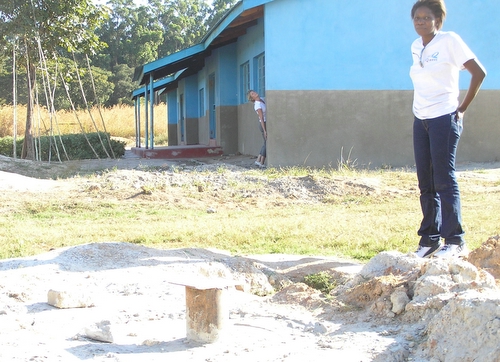
The new bore hole ready for a Playpump
Thursday 12 May 2005 - Visited an 'unofficial' compound squeezed up against the airport fence known as Mackenzie.
I thought that it was difficult at Kaloko ... in Mackenzie, over 500 homes (say 8 per home, 4,000 people), and just two taps, one leaking pipe and three hand dug wells. The school, built and run by a church in town with some other charitable input, caters for 300 orphans - literally. They feed them every day! Isubilo helped by giving them half a dozen bin bags full of shoes (249 pairs - all sizes to order).
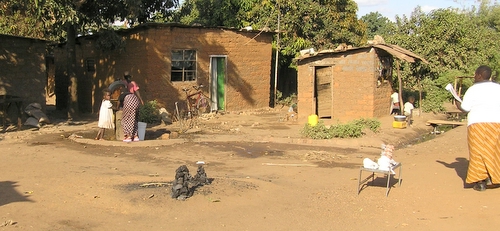
One of two taps ...
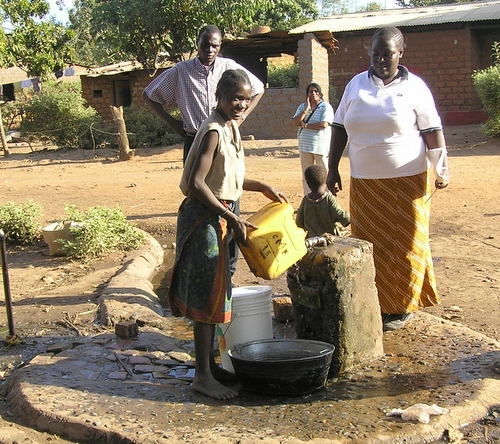
... but actually there isn't a tap (long gone)
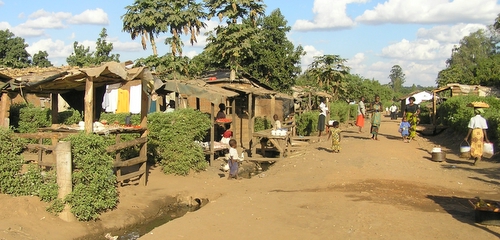
Main street
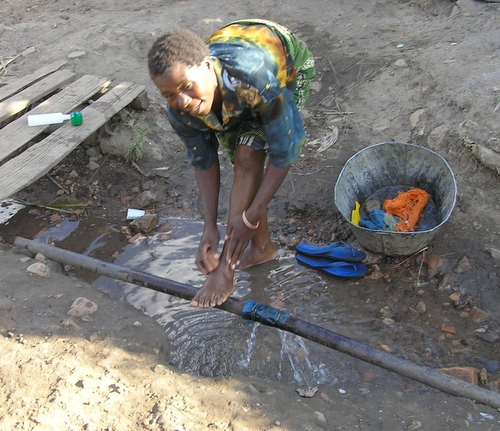
The leak provides another outlet
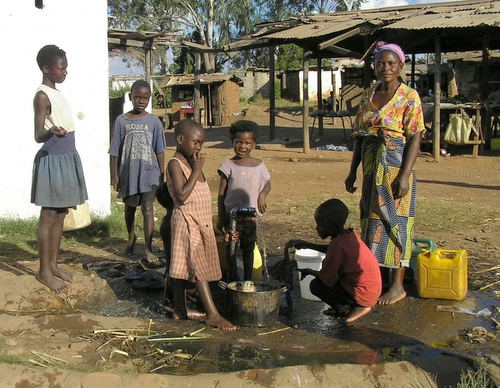
The other 'tap'
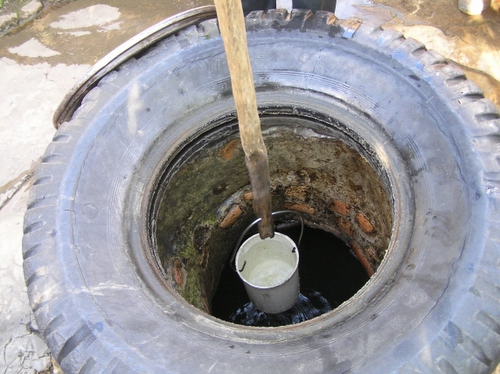
This well is just over a metre deep ...
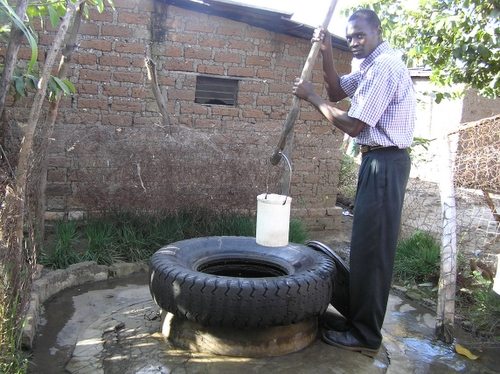
... what about local contamination?
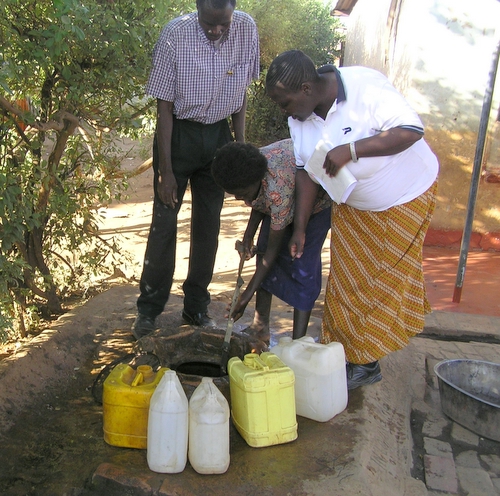
Another well - 5 metres deep
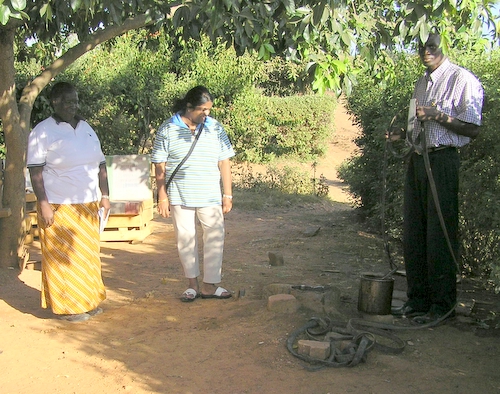
The third well is also 5 metres deep and away from latrines
Friday 13 May 2005 - Francis had been keen to visit Isubilo and meet Andy and it was arranged for this morning at 10am.
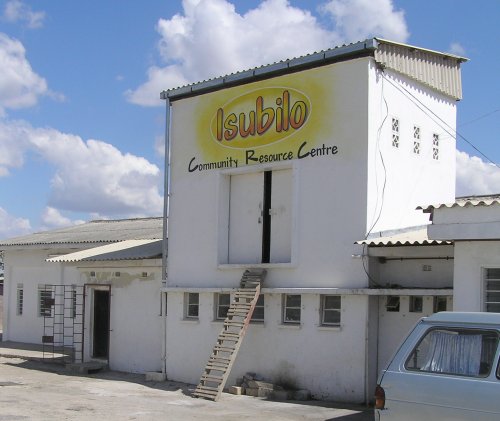
Isubilo Community Resource Centre in Chifubu
At the end of the regular heads of department meeting at Isubilo, Andy outlined the background, purpose and developments relating to my visit. It was noted that Francis would be visiting later that morning.
Francis showed a keen interest in all that was going on at Isubilo. Andy gave the background, ethos, 'kingdom purpose' and future developments and I introduced Francis to various people and departments:
- Phil who works with the 250 orphans and vulnerable children (OVC) who are fed twice a week and have special group activites and games on Saturdays and Wednesday afternoons
- the new maize mill, producing fine mealie meal and bran not just for local distribution but as a service to the local community (cheaper than the commercial mill in town)
- Jimmy, who brings pastoral oversight for the team and is heavily involved in visits to the home-based care (HBC) clients, most of whom have HIV/AIDS. TB is becoming more common
- Isabel is in charge of the storeroom. Isubilo receives and distributes hundreds of childrens' shoes, clothes, blankets for OVC, HBC and others. She is also involved in HBC visits
- HBC is managed by David, who oversees the volunteer church-based 'care-givers' who each have several of the 150 HBC clients to care for.
- Gladson Tanga is the agriculturist with degrees in agriculture and divinity - able to promote plant and spiritual growth! Francis was particularly keen to speak some more with Tanga at another time
- Francis was also shown the clinic and dispensary. Drugs are issued free to all registered clients as well as to those in Ndola prison. There is a full time nurse and also a part-time medical attendant
- He was introduced to the ladies in the kitchen who not only cook for the OVC but provide over a dozen meals for patients in the main hospital - mostly to the HBC patients
- The need for water in the local community was evidenced by the use of Isubilo's own bore hole that provides water, not just for the Centre, but for the long queue of Chifubu's residents. The Kafubu Water Company's water supply rarely makes an appearance at the local taps! Unfortunately The Isubilo well has partially collapsed due to an inadequate well lining so water is limited now to about two hours per day
- The HIV/AIDS support group receives a variety of input: from Jimmy, the pastor; taking part in Alpha courses; providing drama-based support for AIDS awareness teaching in the community
Francis got a comprehensive view of the 'Isubilo Community Resource Centre' that might have a complimentary future role with the 'Mapalo Community Resource Centre'.
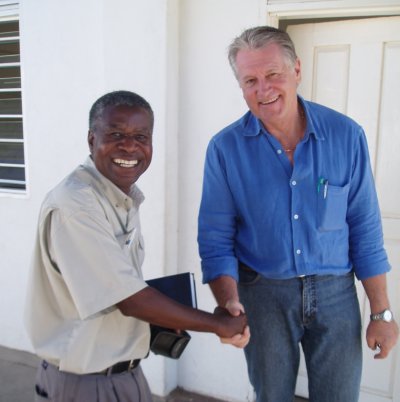
Francis and Andy
Sunday 15 May 2005 - Karen and I attended Ndola Vineyard Church. It was great to 'do' Vineyard in Africa! God is good - everywhere!
I spoke briefly with Damas, the senior pastor, about how the Mapalo Vineyard was started and how the Seeds of Hope connection had been made.
Monday 16 May 2005 - The second visit to the Kaloko compound ...
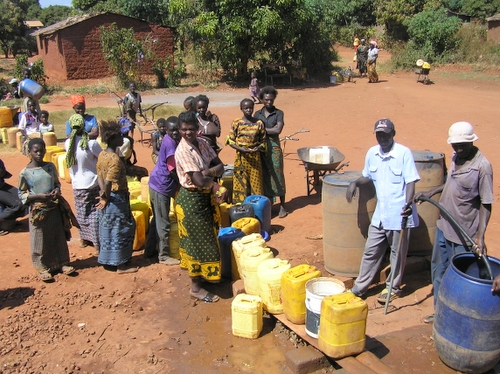
The queue was larger than usual because of lack of supply at a couple
of the kiosks
... on my last visit (with the Lifespring SOBIA outreach team last Monday) one of the pastors, Alec, gave me the contact details of the RDC 'overseer' guy whom I had just missed meeting. As it happens I was on my way to pick up diesel for the farm and was going within half a mile of his house!
Evaristo happened to be in when I called and was very pleased to meet 'the bore hole expert from the UK'. I quickly enlightened him and explained my mission. He then mentioned that he had his own hand dug well in his back garden! This was duly photographed and then we had a significant conversation about the key issues relating to water provision: ownership, management, maintenance, responsibilty. He then explained the plight of another of the compounds which was worse off than Kaloko. It has been provided with three hand-pumped wells, totally inadequate for the number they have to serve, but nevertheless another example of the very thing I have come to look at. We discussed at length the methods whereby churches/RDCs can co-operate to bring about successfully implemented hand-pumped water supplies.
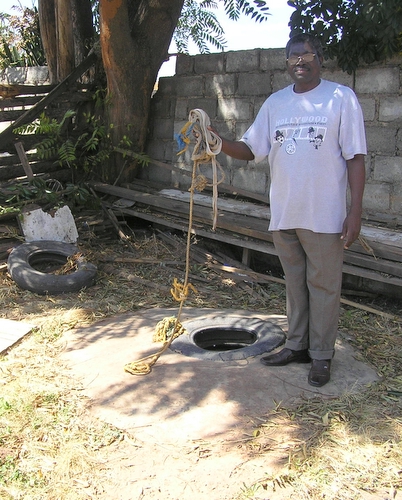
Evaristo's own hand-dug well
As I needed to return with the supply of diesel we arranged to meet up the following day to visit the Bwana Mkabwa township.
Tuesday 17 May 2005 - I picked up Evaristo and we drove to the outskirts of town to the Bwana Mkabwa ('big boss') mining township of 2-3,000 residents.
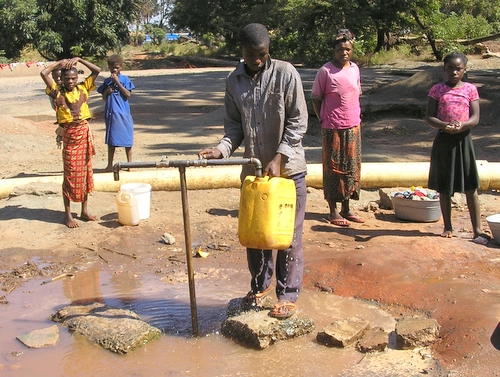
We met an old man there, the oldest in the village, a 'mine' of information. We had come to visit the school initially. About six years ago the electricity supply to the school was cut as the mine closed (it has re-opened since) and so the water tower was no longer filled by the electric pump at the bottom of the bore hole. Two hand pumps were installed, the second in an adjacent bore hole on the school site. About a mile away there was another twin crank hand operated bore hole pump. For those who couldn't afford the K1,000 (12p) a month to use the hand pumps the mine had provided a tap on their own-pumped 12inch water main - but it is about two miles away. In talking with the senior teacher at the school I heard how their pump technician manages the three pumps. Although he has a spare pump washer for the India MkII pumps he is unable to hold further spares as the villagers cannot afford to pay in advance for what is in effect pump insurance. So when a pump fails they get the money together to pay for the necessary parts - and suffer the delay in awaiting delivery.
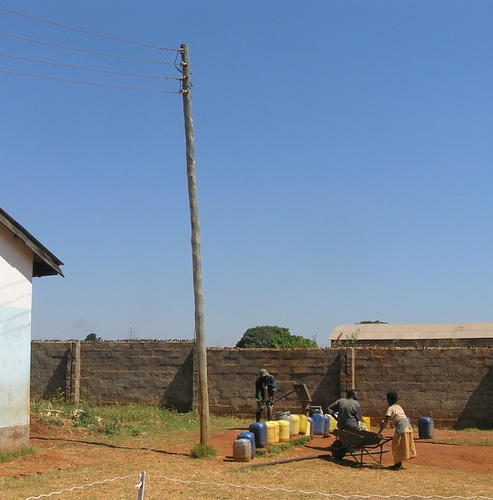
A hand pump where the electric pump used to be
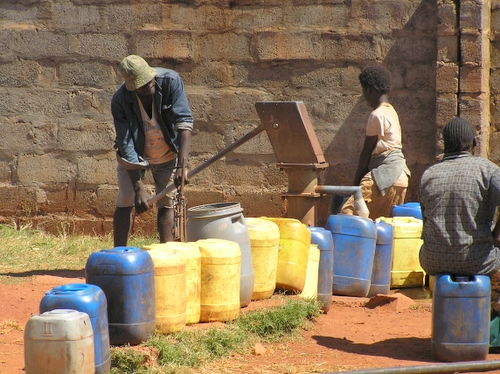
Always a queue
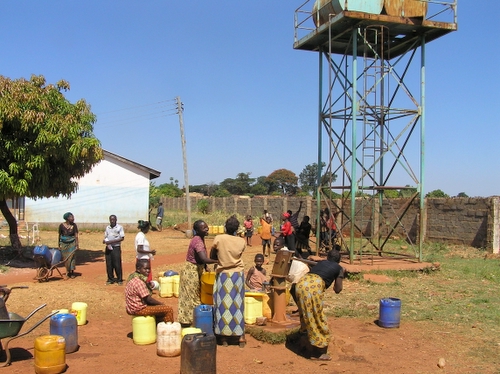
Both pumps in the school premises
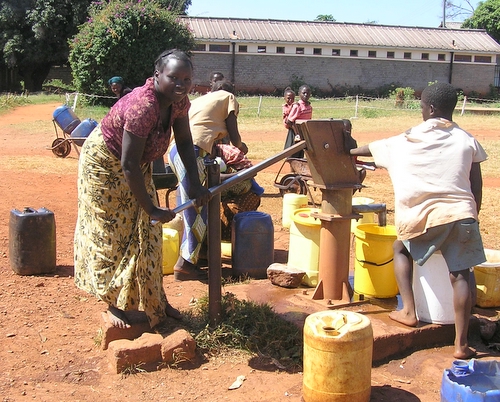
These are India MkII pumps
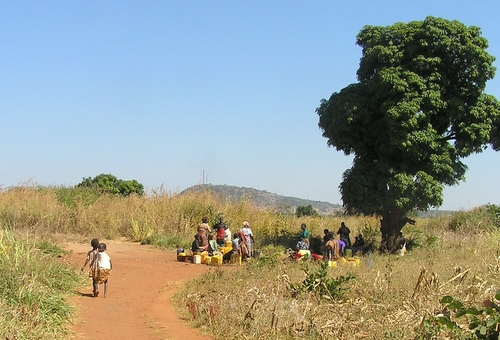
There was a third pump out in the bush
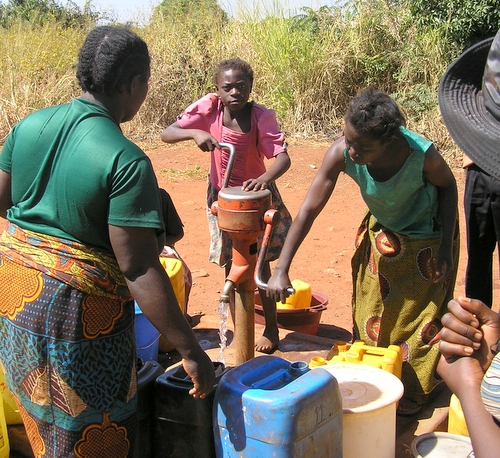
... a rotary twin crank pump
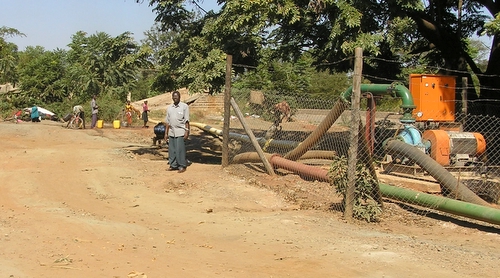
If you couldn't afford the K1,000 a month walk a couple of miles to
this tap on the mining company's water supply
Whilst picking up some hardware supplies in town I noticed that the store had an India MkII on display. In talking to the manager he explained that whereas a month or so ago he could sell them at US$400 retail, because of a hike in the steel price to the Indian manufacturer they were now at least US$550. Joseph, the Mapalo Vineyard pump maintenance trainer, was very keen to explore a low maintenance pump like the Awassa pump as the India MkII presented a lot of work to maintain/repair.
Wednesday 18 May 2005 - Andy called to get an update to see what progress was being made and I gave him the detail of the visits. Various options seem to be emerging:
- Isubilo working with Mapalo with the one large rig
- Isubilo, working with Mapalo, to obtain the small UK rig
- trialling the Awassa pump as soon as possible seems to be a good idea
Thursday 19 May 2005 - Had a further talk with Andy about making contact with the Chifubu RDC and one or two of the Chifubu church leaders. He would arrange same for the next day.
Karen and I enjoyed the traditional Zambian nshima meal with Francis and family in the evening. I updated Francis on my latest visits (complete with photos) and we discussed possible collaboration (the options above). If the Awassa pump can be proven it could be the best pump option.
Friday 20 May 2005 - Met with Andy: visits planned to meet two church leaders in the afternoon. We took a look at the 'new' Isubilo house a hundred metres or so from the Centre. This house will be home to a number of orphans cared for by an Isubilo sponsored foster mother. Unusually for the compound it has been refurbished to include a flush toilet and a shower. Unfortunately, although a fee was paid to the water company for mains water, there is only water for one hour a day. What Andy would like to do is install a small electric pump for the house plus a hand pump for the community - but that means a bore hole is needed!
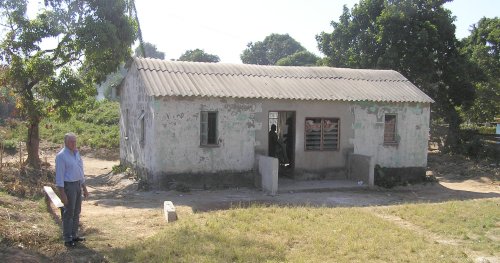
Andy at the Isubilo house
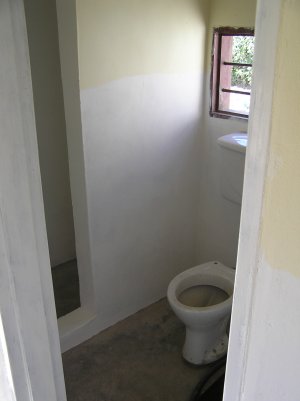
An unusual installation - an inside loo and shower!
Our next call was to the local MP's office in Chifubu. The MP/councillor is responsible for five wards and their RDCs - Chifubu is one of them. The MP's assistant was very willing to hear of the water project that Isubilo is researching. We explained our interest in providing community hand pumps. He was keen to note our ideas about involving community representaives in the process. He suggested that the councillor would want to meet with us and would contact Isubilo.
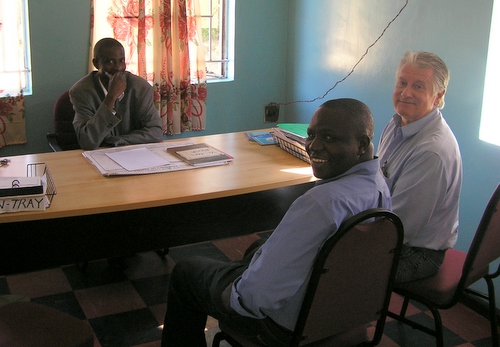
The meeting with the MP's assistant
Andy and I then spent some time brainstorming the feasibility of installing hand pumps in Chifubu discussing a wide range of possibilities. The outcome is listed below:
Borehole Think Tank
To appraise the feasibility of the installation of number of hand pumps in the Chifubu compound (the region surrounding the Isubilo Centre).
Boreholes
DrillingLocation/geology/technical know-how of drilling
- Training of drillers
- Maintenance and supervision of rig
- Staffing - one expert
- Staffing - 2-3 workers
Community leaders consultation
- Organise meetings with community leaders for locations, ownership, running costs, manning
- Staffing - director & assistant
Community instruction/sensitisation
- Organise meeting of users to explain use and responsibilities. To also include HIV/AIDS sensitisation as part of Isubilo's brief
- Staffing - assistant & team (including drama team)
Pump
Options: Awassa, India Mk II, Consallen
The following assumes use of the new Awassa pump and that it meets the expectations in terms of performance, local manufacture and ease of maintenance
Production
- Workshop/tools
- Staffing - 2 (plus) workers
Parts import
- Staffing - technical expert/workshop manager
Materials acquisition
- Staffing - technical expert/workshop manager
Maintenance training
- Preferably a woman
- Maintenance schedule
- Staffing - technical expert/workshop manager
Maintenance/Supervision/Receipt of charges
- Person in charge ('pump supervisor') receives modest fee per container (say K50)
- A set amount has to be paid to Isubilo monthly
- All moneys above the set amount is income for the pump supervisor
- supervisor to be trained in, and responsible for, maintenance and repair of 'their' pump
Community involvement and decision-making
- Hold a general meeting of all community leaders to chose a steering committee. To comprise of:
- one councillor
- one RDC member
- two Isubilo reps
- four church reps
- Steering committee to look at locations of borehole sites
- Steering committee to select/appoint pump supervisors?
- Isubilo to be in overall charge - assumes '1' below
Models
- Isubilo instigated and owned
- Church/school owned
- Community owned (who is the community?)
* * * * *
As I had forgotten to return the Seeds of Hope water project folder to Francis, I dropped it in to him and summarised the ideas Andy and I had just formulated. He too could see the value in pursuing the Awassa pump option as soon as practicable.
In the afternoon our first visit was to a pastor's home where we presented our ideas to elicit his opinion as to their feasibility. He, like the MP's assistant, was very keen on the overall goal and was very helpful in commenting on possible pitfalls in the choices of steering group membership. Significantly he showed us his own 'water supply' - a hole in the ground where water of dubious quality was accessible at about two metres (his home on the outskirts of Chifubu is in a valley well beyond the reaches of the water company's taps).
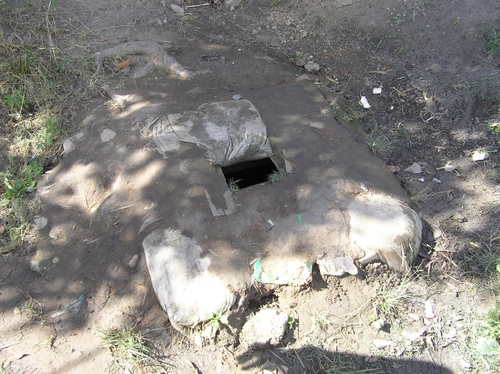
The pastor's back yard 'well'
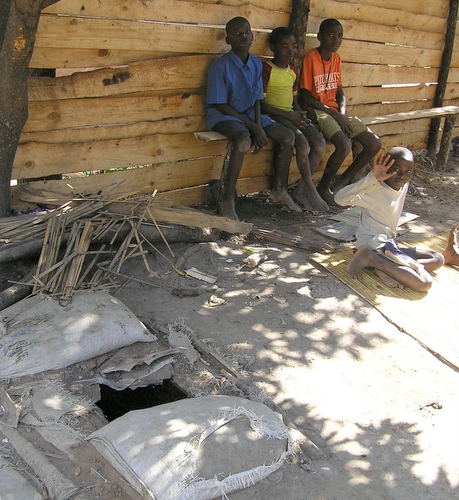
Next door's was no better
Our second visit was to the lady pastor of Chifubu's United Church of Zambia (UCZ). She too was interested and also helped in pointing out some of the difficulties associated with ownership, responsibility and accessibility. She suggested we attend the MP's offices on Monday morning at the end of business of the regular committee meeting held there. The committee meets to discuss projects proposed by the community and manages bids for these projects.
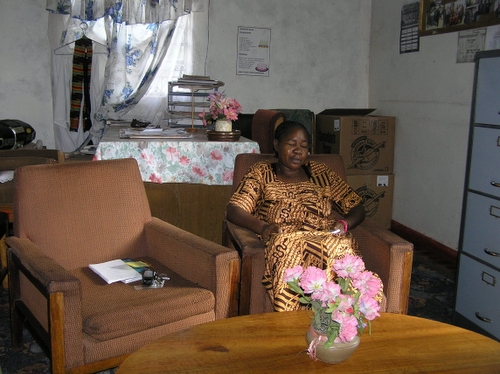
The UCZ pastor also pointed out some of the difficulties to overcome
Monday 23 May 2005 - Another 'chance-God-arranged' meeting: due to slight change of route to meeting up with Andy I walked past the Drill Africa Ndola HQ. I enquired of guy who was just leaving who said that I should speak to his brother in the office. I then spent over an hour with the brother, the MD of Drill Africa! I wanted to get a price for well linings. He told me a great deal more about drilling, well depths, well linings, etc. I even came away with a sample of plastic well lining!
On arrival at the Chifubu MP's office we discovered that the community committee hadn't met after all as the MP/councillor was not in town.
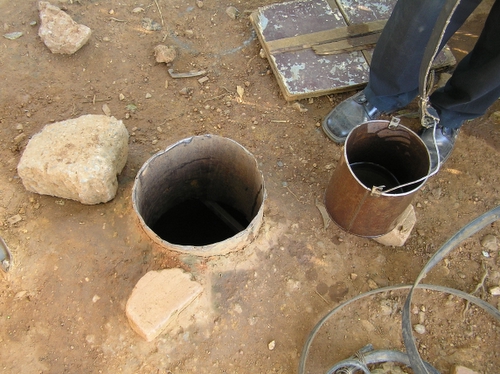
On showing the well lining to Andy he had the idea to resolve Isubilo's own well problem with re-lining their own bore hole with the well lining I had just got a price for. As mentioned earlier, their well has a problem: there is insufficient well lining which caused the wall to collapse at the bottom wrecking the previous pump. We plumbed the well and found it to be 37m deep - the well lining is 30m. So it was decided to buy 13 lengths of well lining (£200 instead of £2,000 - the quote for a new bore hole!) Another visit to Drill Africa and a promise from them to deliver the following day.
Tuesday 24 May 2005 pm - The well lining arrived, Andy had lifted the pump out ready and had gone to town for some more pipe clamps ... it was 4 o'clock ... there wasn't a lot of time ... so with the help of Gladson, Yoano, Jims and some rope we started lowering the new lining. Success!
Wednesday 25 May 2005 - Althouth the Isubilo well can't provide water 24/7 it provides much more than the two hours a day that was available after the well collapse. So it seems there's enough water with the pump lowered 4m to keep the three large tanks full.
The start of the trip back home ...